
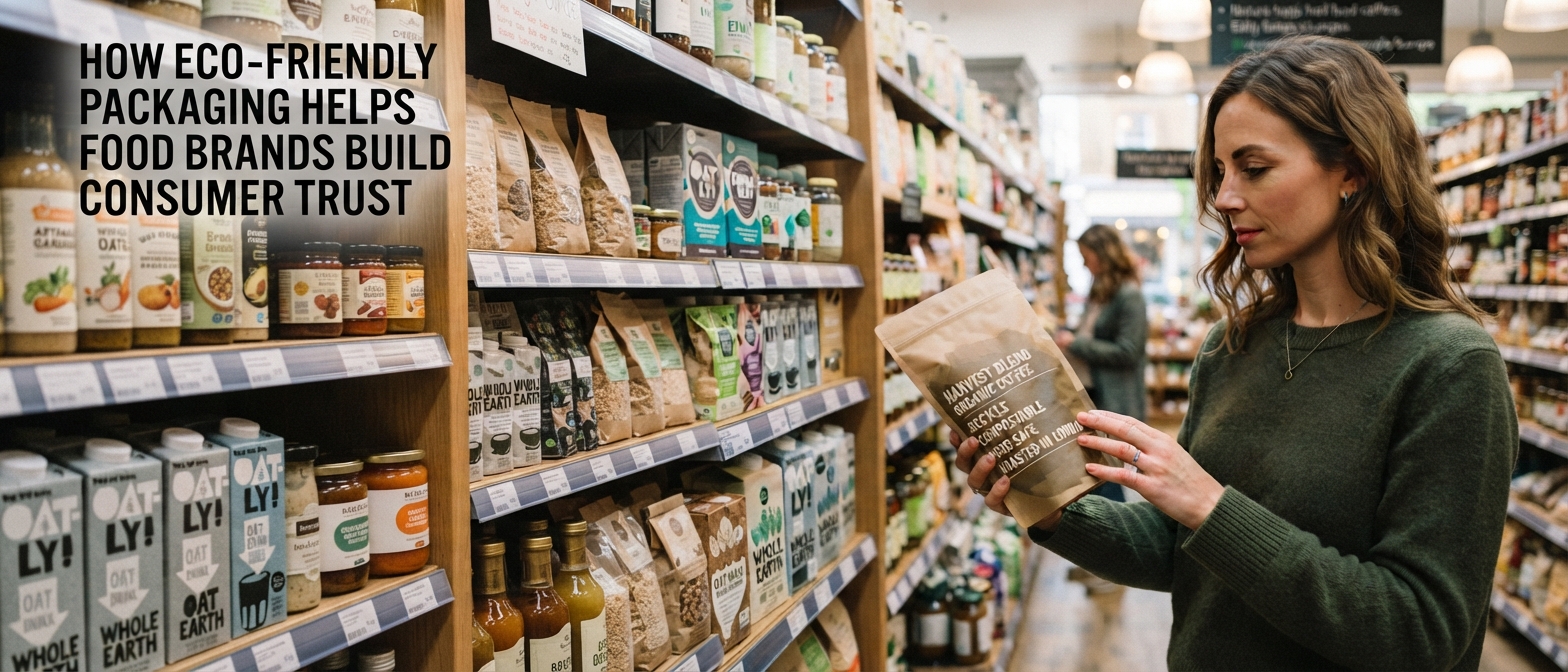
A food package does more than protect what is inside. It is one of the few brand touchpoints consumers physically pick up, read, use, and eventually throw away. A digital ad can disappear with one swipe; the package stays in the shopper's hands. That makes packaging a form of visible evidence. When you choose recyclable pouches, for example, the material choice can show how seriously your brand treats sustainability.
Still, a green-looking package is not a trust machine. Consumers want claims they can understand, verify, and act on.
Consumers Judge More Than the Food Inside the Package

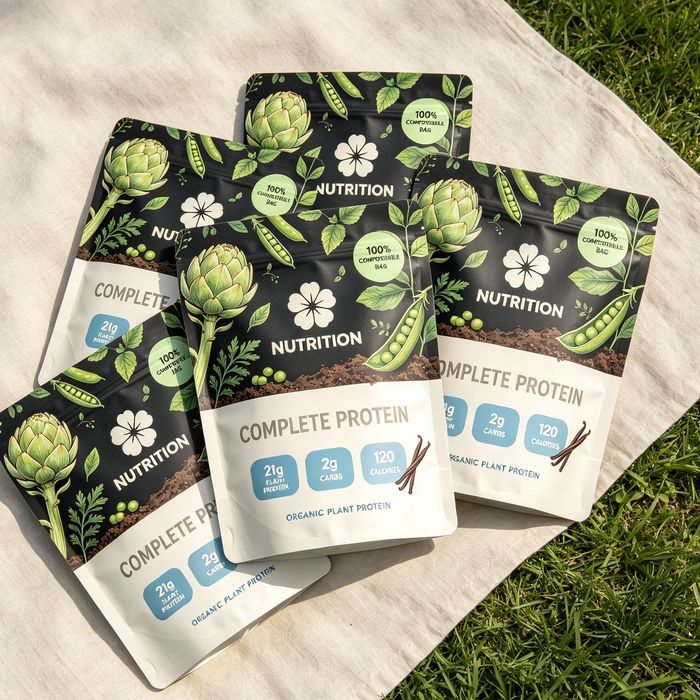
A digital ad can be skipped. Packaging usually cannot.
For food brands, the package follows the consumer through three distinct moments: the shelf, the meal, and the disposal bin. Each moment creates a different trust signal.
At the shelf stage, consumers make a quick first judgment. They see the pouch, feel the paperboard, read the front panel, and notice the claims. Print quality, material appearance, package structure, and labeling all play a part. A package that looks considered and communicates clearly can support perceived product quality.
At the consumption stage, the questions become more practical: Is this packaging safe for food? Does it smell unusual? Is oil leaking through the material? Consumers may never ask these questions out loud, but they notice the answers.
Food packaging carries extra weight because it sits directly between the consumer and something they eat or drink. Concerns about material authenticity, coatings, additives, and chemical migration can therefore matter more than they might for many non-food products.
Then comes the disposal stage. This is where a sustainability claim meets the real world. If the package says it is recyclable or compostable but gives consumers no useful direction about what to do with it, the claim can feel frustrating—or worse, performative.
Eco-friendly packaging cannot replace food quality, safety, or a reliable product. It can, however, reinforce your brand's credibility. Or chip away at it.
What the Data Shows: Sustainable Packaging and Real Purchase Decisions
of consumers say packaging sustainability can influence their purchasing decisions.
of consumers expect brands to provide clearer information about packaging disposal.
say environmental considerations can affect how they perceive a brand.
There is an important difference between what consumers say they want and what they actually buy.
A joint analysis by McKinsey & Company and NielsenIQ tracked five years of actual U.S. fast-moving consumer goods sales from 2018 to 2023. Products carrying ESG-related claims recorded approximately 28% cumulative growth, compared with about 20% for products without such claims, and products with ESG claims accounted for approximately 56% of category growth during the period.
The useful point is not simply the percentage. It is the methodology.
The analysis looked at actual purchase and sales data, rather than relying only on consumers saying they intended to buy sustainable products. That matters. A survey can capture good intentions; a purchase record shows what happened at the checkout counter.
For food brands evaluating whether sustainability can influence commercial performance, that distinction is hard to ignore.
McKinsey's U.S. packaging research also found different levels of willingness to pay for sustainable packaging: about half of consumers were willing to pay 1%–3% more, while roughly one-quarter were willing to pay 4%–7% more.
Consumer attitudes also show some persistence. In its 2025 research, McKinsey reported that 44% of consumers considered environmental impact "extremely or very important," returning to the level observed in 2020.
Certification can add another layer of credibility. An Amazon Ads 2025 study covering the U.S., U.K., and Canada found that 51% of consumers said they were willing to pay more for products carrying a third-party sustainability certification; the U.S. figure was 52%.
The message is not that every sustainable package will command a premium. Markets, products, and price points still matter. But sustainability can influence purchasing—and credible proof gives the message somewhere to stand.
Five Ways Eco-Friendly Packaging Builds Trust
Third-Party Certification Beats Self-Declared Claims
A leaf icon is easy to print. Verifiable certification is harder to fake.
That difference matters because consumers usually have no practical way to verify a brand's self-declared environmental claim while standing in a store or browsing a product page. A credible third-party certification can provide an independent basis for the claim through defined requirements, certification records, and ongoing oversight.
Research from the European Commission found that 61% of consumers said they had difficulty identifying which products were genuinely environmentally friendly, while 44% said they did not trust this type of information. The research also found that many consumers struggled to distinguish self-declared environmental labels from third-party certification marks.
That confusion creates an opening for brands that communicate certification correctly.
Do not rely on a generic green symbol and hope it carries the message. Where applicable, show the full certification name, certification organization, and certificate or license number. Consumers may not check every number. Auditors and procurement teams might. Either way, the evidence is there.
Trust needs a trail.
Clear Disposal Instructions Close the Intention-Action Gap
A consumer can genuinely want to recycle or compost your packaging and still have no idea what to do with it.
That is the intention-action gap.
A useful disposal label should answer practical questions: What is the package made from? Does it need to be emptied or cleaned? Do separate components need to come apart? Which waste stream should it enter? Do local recycling rules change the answer?
The How2Recycle system is a useful reference because its labels focus on practical sorting instructions rather than simply declaring that a package is recyclable.
Compostable packaging needs even more careful wording. Industrial or commercial compostability is not the same as home compostability. A compostable coffee pouch, for instance, may need a commercial facility with controlled conditions. A backyard compost pile is another matter entirely.
If a package requires commercial composting facilities, saying only "compostable" can leave consumers with the wrong impression.
The How2Compost program, developed with the Biodegradable Products Institute (BPI), provides an example of how compostability labeling can be tied to certified products rather than broad, unsupported claims. This approach is especially relevant when you are evaluating compostable packaging bags for food products.
Good packaging tells consumers what to do next.
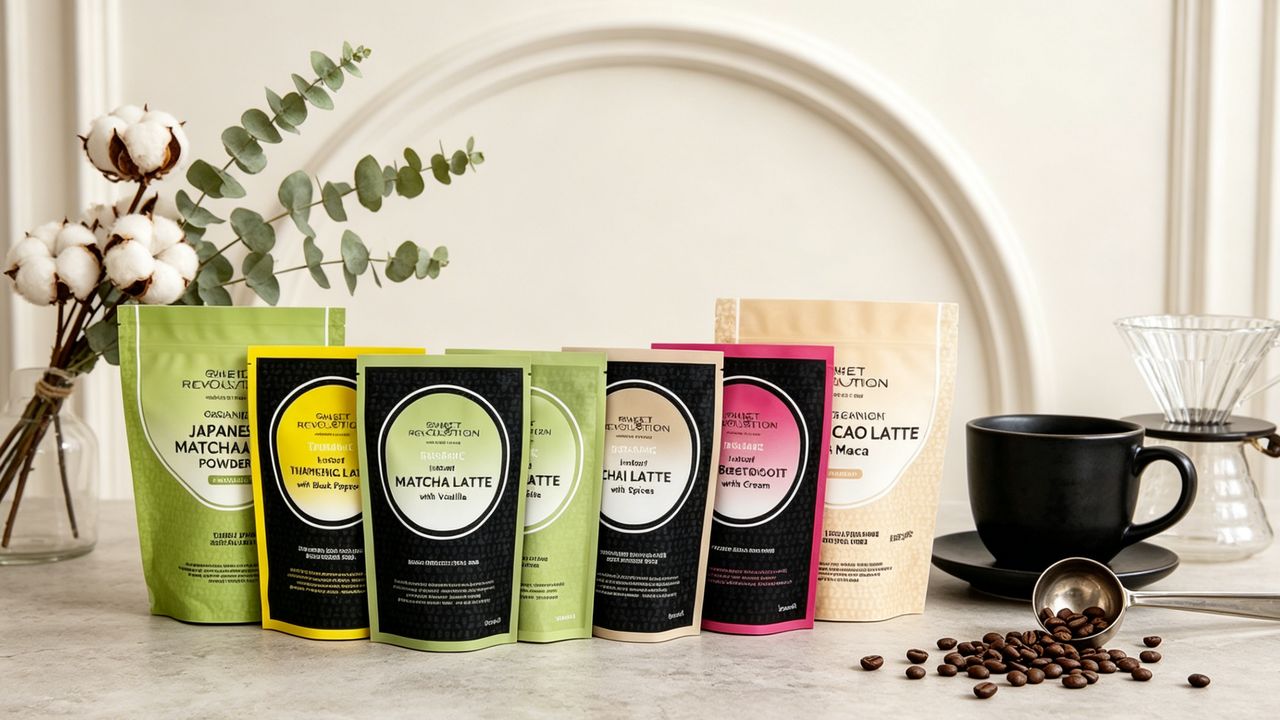
Food-Contact Safety and Chemical Transparency
Sustainability and safety should not sit in separate packaging conversations.
When consumers see an environmentally positioned package, some may naturally expect it to be a safer or "cleaner" material choice. That assumption is understandable, but it is not always something brands should take for granted. The environmental story and the food-contact reality need to match.
This is particularly relevant to PFAS. Several U.S. states have introduced restrictions on intentionally added PFAS in food packaging, including New York, California, Washington, Vermont, Connecticut, and Maine, with different scopes and effective dates. California's AB 1200, for example, addresses PFAS in plant-based food packaging and took effect in 2023, while Maine's related requirements take effect in 2026.
The regulatory direction is broader than any single state. Under the EU Packaging and Packaging Waste Regulation (PPWR), restrictions on PFAS in food-contact packaging apply from August 2026.
For brands, the practical takeaway is not to turn "PFAS-free" into another unsupported marketing slogan. Ask your supplier for appropriate documentation and testing evidence. Review the coating system. Confirm that the material used on the production line matches the claim printed on the pouch.
Compliance is becoming part of the trust story.
Verifiable Material Content and Recycled Inputs
"Made with recycled material" sounds useful until someone asks one simple question:
How much?
A stronger claim identifies the material content and, where relevant, distinguishes between post-consumer recycled (PCR) and post-industrial recycled (PIR) content.
For example, a statement such as "contains 30% post-consumer recycled (PCR) paperboard" gives consumers and procurement teams considerably more information than "made with eco materials."
This distinction is also becoming increasingly important as packaging regulations introduce more specific requirements around recycled content. The EU PPWR includes phased minimum recycled-content requirements for certain plastic packaging.
That means packaging buyers should not evaluate sustainability claims from the artwork alone. Ask what sits behind the print: material specifications, recycled-content information, supplier records, and supporting documentation.
A precise claim is easier to trust—and easier for a procurement team to audit.
Consistency Between On-Pack Claims and Brand Behavior
A package is rarely the only place consumers encounter a sustainability claim.
The same message may appear on your website, product listing, social media, customer service scripts, sustainability documentation, and retailer materials. If one channel says "home compostable" while another says "commercially compostable," consumers have a reason to hesitate.
Kantar's 2023 global research found that an average 52% of respondents reported having seen or heard false or misleading information from brands about sustainability actions.
That is a warning about consistency, not simply advertising.
Every touchpoint should connect. The package should match the product page. The product page should match the customer-service answer. The customer-service answer should match what the material can actually do.
Your packaging supplier is part of that chain. Material specifications, certification records, test reports, artwork details, and production documentation should be traceable enough that the claim printed on the finished package can be connected back to the evidence behind it.
The package should tell the same story as the brand.
Certifications That Carry Weight: A Market-by-Market Reference
The Regulatory Backdrop: Compliance as a Trust Infrastructure
For food brands, it helps to look at certifications through four practical lenses: what they certify, which standard they use, which market they serve, and how the certification should appear on packaging.
Fiber sourcing is not compostability. Compostability is not recyclability. Mixing them together is an easy way to confuse consumers—and your own compliance team.
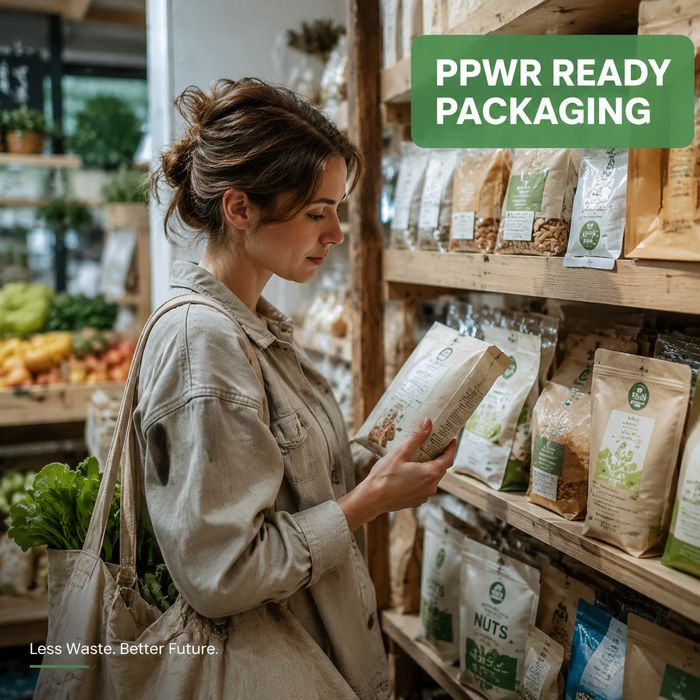
EU PPWR: What Food Brands Exporting to Europe Must Track
The Packaging and Packaging Waste Regulation (PPWR) is directly applicable EU legislation, so brands outside the EU cannot simply treat it as a domestic European supplier issue if their products enter the EU market.
Food brands should track at least five areas:
Packaging design requirements — including requirements related to recyclability and packaging minimization.
Recycled content — particularly phased requirements for plastic packaging.
Compostable packaging — including the product categories and conditions where compostable formats are relevant.
PFAS restrictions — especially for food-contact packaging.
Labeling and disposal information — as the EU moves toward more harmonized packaging communication.
The practical point is simple: do not wait until artwork is finished to ask whether the package meets the target market's requirements.
Choose the material, review the structure, and check the documentation first. Then print.
The U.S. Patchwork: State Rules and Federal Guidance
The U.S. presents a different challenge.
Instead of relying on one comprehensive packaging framework, brands may need to navigate a combination of federal requirements, state-level restrictions, recycling systems, and environmental-claim guidance.
PFAS rules are a clear example. Different states have adopted restrictions with different effective dates, product scopes, and requirements.
For brands selling nationally, maintaining several packaging versions can create additional complexity in procurement, inventory, artwork management, and production. In some cases, designing a single SKU around a stricter requirement can be operationally simpler than maintaining multiple regional versions—but that decision should be made through a product-specific compliance review rather than assumed universally.
Ask your packaging supplier for an up-to-date compliance matrix covering the markets where your packaging will actually be sold.
It is cheaper to clarify the requirements before printing than after the cartons arrive.
Final Takeaway
Eco-friendly packaging does not build consumer trust simply because it looks sustainable.
It builds trust when consumers can understand what the package is made from, why that material was selected, how the package should be handled after use, and what evidence supports the environmental claim.
For food brands, the strongest approach connects five elements:
credible certification + clear disposal guidance + food-contact safety + verifiable material content + consistent brand behavior.
That combination turns sustainability from a marketing statement into something more useful: evidence that consumers, retailers, and procurement teams can actually evaluate.
For packaging buyers, the next step is to bring those requirements into the sourcing conversation early. DINGLI PACK can support custom packaging projects with material selection, printing, structural design, and production documentation aligned with the requirements of your target market.
Whether you are sourcing custom PLA-lined compostable coffee bags, custom mono PE recyclable rollstock film, or custom printed recyclable stand-up cookie bags, the questions should go beyond appearance: What can the material do? What can you prove? And what will consumers actually understand?
If you are evaluating recyclable or compostable packaging for a food product, you can contact DINGLI PACK to discuss your material, format, printing, and market requirements. You can also learn more about our packaging capabilities on the DINGLI PACK website.
Frequently Asked Questions
01 Is compostable packaging better than recyclable packaging for food?
02 How do I choose the right food packaging bag for my product?
03 Which pouch size, bag style, and closure should I choose?
04 How can food packaging protect shelf life during storage and transportation?
05 Are custom food packaging materials compliant with food-contact requirements?
06 What should B2B buyers know about MOQ, pricing, and packaging support?
ONE-STOP PACKAGING SOLUTION - From Concept to Shelf in 7 Days
At DINGLI PACK, we know how stressful packaging can be for small brands, store owners, and startups. That’s why we focus on making it simple, reliable, and tailored to your needs. From stand up pouches, coffee bags with valves, flat bottom bags, spout pouches, shrink sleeves...
Our team provides hands-on support—from free package design and material advice to practical OEM guidance—making sure your product looks great and stays protected. Want to see us in action? Check our Video Center.
With a 5,000 m² workshop and 24/7 support, we deliver fast replies, consistent quality, and peace of mind. Stay updated with our tips and stories in the News Section, or explore all our solutions on the Products Page.
We’re more than a supplier—we’re a partner who understands the challenges of growing a brand and is ready to make your packaging shine.
Related Packaging Solutions

HuizhouDingli Packaging Products Co.Ltd.


Post time: Sep-15-2026