
Have you ever looked at a package labeled “recyclable” and wondered if it actually means anything in the real world? Or whether it just sounds good on a shelf? For many brands, this is no longer a theoretical question. With tightening regulations across Europe and the United States, packaging decisions are becoming both a compliance issue and a reputation issue at the same time.
At DINGLI PACK, we’ve seen how often “recyclable” gets misunderstood. Sometimes it is technically correct, but practically misleading. Sometimes it is just wrong. And increasingly, regulators are starting to care about the difference.
This article looks at what actually happens to packaging materials once they enter recycling systems in Europe and the US, based on the direction of 2026 regulations such as the EU PPWR framework and updated US EPA guidance. Not in theory, but in how systems really behave.
Why “Recyclable” Labels Don’t Always Mean What You Think

The idea of recyclability sounds simple, but the reality is fragmented. Europe and the US do not operate as unified systems. Europe is more structured on paper, yet recycling performance still varies widely between countries. Germany and its high-performing collection systems sit in sharp contrast with lower-performing regions such as parts of Southern Europe. The gap in recovery rates can easily reach 30–40%.
The US is even more decentralized. Recycling is defined locally, often by municipalities. A material accepted in one city may be rejected in another just a few hours away. So when a brand says “recyclable in the US,” it often depends on where the consumer happens to live.
There is also a more subtle issue that tends to be overlooked: something can be technically recyclable without being practically recycled. If there is no infrastructure, or if sorting systems cannot process it efficiently, it simply does not re-enter the material loop.
This gap between theory and reality is exactly why regulators are tightening control. Under the EU PPWR framework, misleading environmental claims may lead to penalties of up to 4% of global annual turnover. In the US, the FTC Green Guides are pushing brands toward clearer, more defensible language, especially around environmental claims and labeling.
In simple terms, “recyclable” is no longer a marketing phrase. It is becoming a legal statement.
How Different Materials Actually Perform in Recycling Systems
Plastic Packaging
Plastic is probably where the biggest confusion sits. PET and HDPE are generally well supported in both Europe and the US recycling systems, largely because collection and sorting infrastructure for bottles is relatively mature. PP is somewhere in the middle, depending on region and application. LDPE films, however, are far more problematic. Even if they are technically recyclable, collection rates remain low.
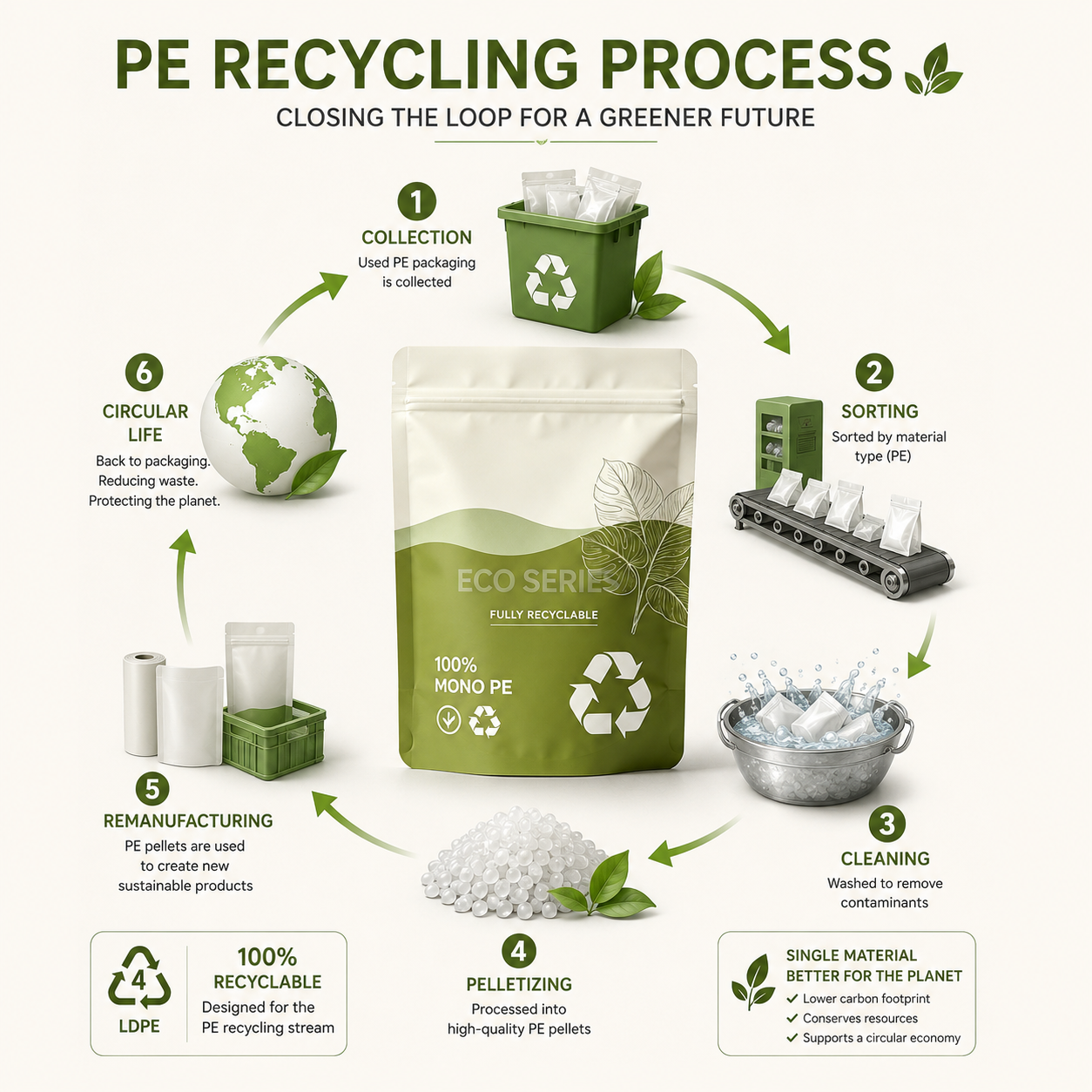
From a brand perspective, this is where material simplification starts to matter. Mono-material structures such as Mono-PE or Mono-PP are increasingly preferred because they avoid the complications of layered films that cannot be easily separated.
Paper and Cardboard
Paper feels like the safest option, and in many cases it is. Kraft paper and corrugated cardboard are widely recycled across both regions. But the situation becomes less straightforward once coatings, laminations, or heavy ink coverage are involved.
A coated paper that looks premium on the shelf may quietly become difficult to recycle at scale. That is often where recyclability breaks down, not in the material itself but in the finishing choices made during design.
Metal Packaging
Metals such as aluminum and steel perform relatively well in recycling systems. Aluminum in particular is valuable enough that it tends to stay within the recycling loop. The challenge is less about recyclability and more about ensuring that coatings or composite layers do not interfere with processing.
When designed carefully, metal packaging can remain one of the most stable circular materials available today.
Composite and Multi-Layer Materials
This is where things become more complicated. Flexible pouches, barrier films, and laminated structures are widely used because they perform well in protecting products. But they are also the most difficult to recycle in current systems.
In many cases, these materials are classified as non-recyclable not because recycling is impossible, but because separation is too complex or economically inefficient.
Europe vs United States: Real-World Recycling Performance
It is easy to assume Europe and the US are similar in sustainability standards, but packaging regulation tells a different story. Europe is moving toward stricter mandatory recycled content requirements, while the US relies more on state-level enforcement and voluntary industry alignment.
For example, EU policies under PPWR are pushing for minimum recycled content across multiple packaging categories by 2030, while the US framework remains more flexible but less uniform.
In practice, this means brands operating globally often need to design packaging that satisfies the stricter European requirements first, then adapts to US regional variations.
| Material | Europe Recyclability | US Recyclability | 2026–2030 Regulation Direction | DINGLI PACK Approach |
|---|---|---|---|---|
| Paper & Cardboard | High | High | 30% recycled content target in EU | FSC-certified paper solutions |
| Glass | High | Medium | No mandatory content rules | Lightweight glass optimization |
| Aluminum | High | High | 50% recycled aluminum target in EU | Ultra-thin aluminum packaging |
| PET | High | High | 25% recycled content in EU | Food-grade rPET solutions |
| PP | Medium | Medium | Must be recyclable by 2030 in EU | Mono-PP structures |
| Composite materials | Low | Low | Restrictions increasing | Mono-material alternatives |
Common Misunderstandings Around Recycling
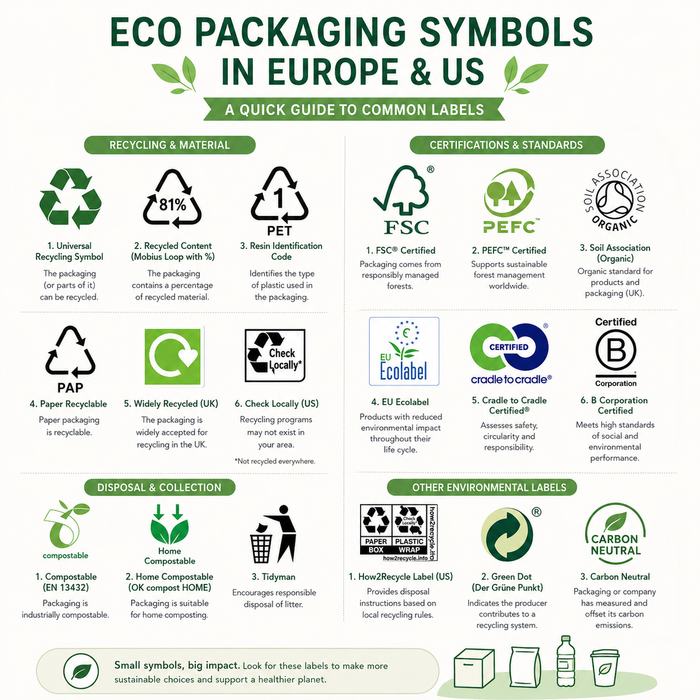
One of the most persistent misunderstandings is the assumption that a recycling symbol automatically guarantees recyclability. In reality, symbols often indicate material type rather than actual processing capability.
Another common issue is the belief that biodegradable materials are equivalent to recyclable ones. They are not. Biodegradable simply means it can break down under certain conditions, which is unrelated to whether it can re-enter industrial recycling systems.
There is also a tendency to assume that rinsing packaging automatically makes it recyclable. While cleanliness helps, contamination is still one of the main reasons entire batches are rejected.
How Brands Can Make Better Packaging Decisions
In practice, choosing recyclable packaging is less about a single material and more about a design philosophy. Simpler structures tend to perform better. Single-material systems are easier to process. Excessive decoration often works against recyclability.
Brands that think ahead often design packaging not just for shelf impact, but for end-of-life behavior. That includes how labels peel, whether adhesives interfere with sorting, and whether materials can actually be separated without special tools.
At DINGLI PACK, we focus on this exact intersection between compliance and practicality. Our packaging solutions are designed to align with evolving EU PPWR requirements and US EPA guidelines, while still meeting commercial expectations for branding and performance. We also provide free recyclability assessments for brands trying to navigate these changes more confidently.
If you are exploring compliant packaging solutions, you can reach us directly through our contact page or learn more about our company on the homepage.
References
Frequently Asked Questions
Is packaging labeled “recyclable” always actually recyclable?
Not necessarily. In many cases, “recyclable” refers to technical recyclability rather than real-world processing capability. If local infrastructure does not support collection or sorting, the material may still end up as waste.
What packaging materials are easiest to recycle in both Europe and the US?
Paper, cardboard, PET, HDPE, and aluminum generally perform best across both regions. These materials benefit from relatively mature collection systems and higher recycling demand in secondary markets.
Are plastic bags and flexible pouches recyclable?
It depends on the structure. Mono-material plastic films like Mono-PE may be recyclable in some systems, while multi-layer laminated pouches are often not due to separation and processing limitations.
What is the difference between recyclable and compostable packaging?
Recyclable packaging is designed to be reprocessed into new materials, while compostable packaging breaks down under specific industrial or natural conditions. They belong to different waste streams and should not be treated as interchangeable.
How can brands ensure their packaging complies with EU and US regulations?
Brands need to consider both material selection and design structure. Working with an experienced supplier like DINGLI PACK helps ensure compliance with EU PPWR requirements and US EPA guidelines, especially when it comes to single-material design and verified recyclability claims.
ONE-STOP PACKAGING SOLUTION - From Concept to Shelf in 7 Days
At DINGLI PACK, we know how stressful packaging can be for small brands, store owners, and startups. That’s why we focus on making it simple, reliable, and tailored to your needs. From stand up pouches, coffee bags with valves, flat bottom bags, spout pouches, shrink sleeves...
Our team provides hands-on support—from free package design and material advice to practical OEM guidance—making sure your product looks great and stays protected. Want to see us in action? Check our Video Center.
With a 5,000 m² workshop and 24/7 support, we deliver fast replies, consistent quality, and peace of mind. Stay updated with our tips and stories in the News Section, or explore all our solutions on the Products Page.
We’re more than a supplier—we’re a partner who understands the challenges of growing a brand and is ready to make your packaging shine.
Address
Block B-29,
VanYang Crowd Innovation Park ,
No 1 ShuangYang Road,
YangQiao Town, BoLuo District,
HuiZhou City, 516157, China
Phone
Support: +86 13410678885
Hours
Monday-Friday: 9am to 6pm
Saturday, Sunday: Closed


Post time: Jun-01-2026